The Future of CDFIs is a Narrow Bridge
Presented March 23, 2026, by Mark Pinsky, CDFI Friendly America’s President, at the New York State CDFI Coalition Conference in Albany, NY. Click here to download Mark’s speech as a PDF.
“
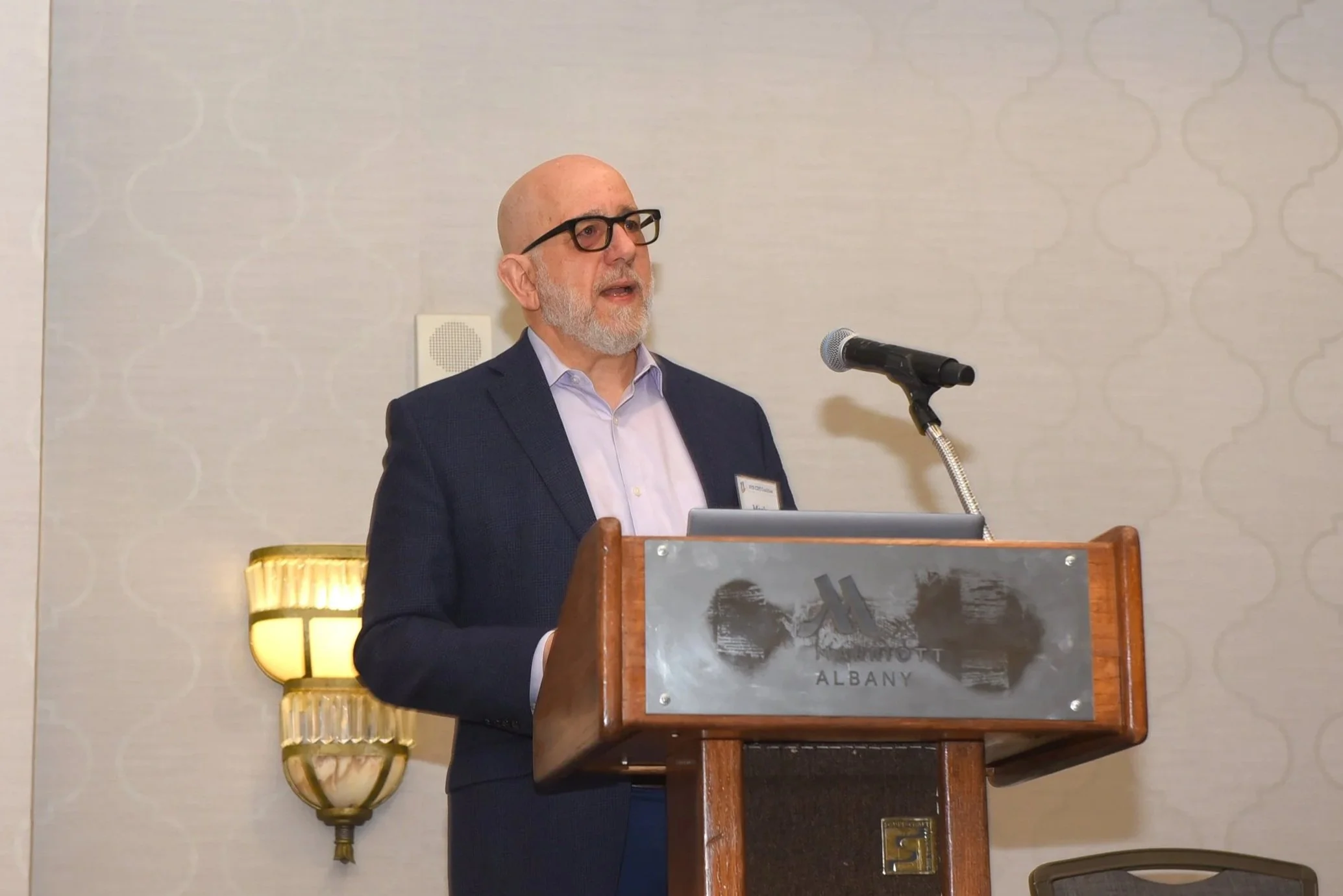
Mark Pinsky speaking at the 2026 New York State CDFI Coalition Meeting.
Credit: Joan Heffler Photography
Good morning!
I am grateful and excited to be here today to talk about the Future of CDFIs. Thank you to the Board of the New York State CDFI Coalition and to Colleen Ryan, your executive director.
33 and 34 years ago, I was a consultant running a CDFI Coalition—what we know now as the national CDFI Coalition—at the start of the work that led to the CDFI Fund. That’s where I met Cliff Rosenthal, who I will be talking with tonight. Cliff had a vision in the 1980s, and we all still benefit today from what he imagined for our nation and for our industry.
The theme of this conference is “CDFIs at Work: Bridging the Gap.” I titled my comments, “The Future of CDFIs is a Narrow Bridge.” I am not suggesting that we are one misstep away from disaster. My point comes from Rebbe Nachman, a 19th-century Rabbi from what is now Poland, who famously said that all the world is a narrow bridge and the important thing is to never be afraid.
I will explain what I mean toward the end of my comments, after I reflect on why we do this work, what we could have done better in 2025, and what we must do in 2026 and beyond to make sure that the future of CDFIs is bright.
The fundamental responsibility all CDFIs share is to play a transformative role in a transactional business.
The most familiar transformation happens because of you, day in and day out, at the individual CDFI loan level—the microentrepreneur who launches a business that enables her to afford better housing for her family or the returning citizen who saves money for the first time in his life in a credit union account.
Another type of transformation happens at the community level. For example, the rising economic confidence and agency of a community of color that now has a neighborhood bank after struggling without one for decades. Or the changes in social systems and dynamics that result from the financing of a laundromat that saves time for residents and increases social engagement among diverse populations. How about the impact on communities when a new healthy foods store opens?
You can teach me more about those examples and thousands more. In all my years, I never had the good fortune to work full-time in a CDFI community.
There are four more levels of transformative change I want to talk about today.
First, CDFI industry transformation—changing in material ways how CDFIs work, where they work, and how they work together. For example, the introduction in the mid-1990s of the Equity Equivalent investment product among loan funds when I was at OFN and Secondary Capital for credit unions when Cliff led Inclusiv. Both products were introduced system-wide, but both grew from individual CDFI needs and recommendations. It’s worth mentioning that both were meant, in large part, to address the likelihood at the time that the CDFI Fund wouldn’t last long as a source of net worth or equity.
Second, financial system transformation—CDFIs transformed how and how much banks and the mainstream financial system relate to communities and community development, generally, and underserved communities specifically. Until 1992, when candidate Bill Clinton suggested a role for institutions that we did not yet call CDFIs, and 1993, when President Bill Clinton offered a vision linking CDFIs to the Community Reinvestment Act (CRA), banks struggled to make meaningful investments in low-income and other disinvested communities.
CDFIs changed that. They made it easier for banks to lend into disinvested communities and so increased the scale at which banks and non-bank financial institutions now invest in historically under-invested, undervalued, and misunderstood people and places.
CDFIs also transformed how mainstream financial institutions understood risk in what were to them unfamiliar markets. CDFIs showed bankers that things they considered impossible are possible; that there is a good business doing what we do when you are not striving to maximize profit.
As a result, the amount of investments grew by orders of magnitude both through CDFIs and through direct bank investments. During the Great Recession, banks came to see CDFIs as their best allies. More than one big bank CEO realized then that CDFIs were still lending when their own banks were not, and their respect grew. Bank CEOs, Federal Reserve System Chairman Ben Bernanke, and other financial system power brokers spent a disproportionate amount of time talking publicly about their appreciation for CDFIs in hard times and better times.
That led Goldman Sachs and Lloyd Blankfein, its CEO at the time, to turn to CDFIs with its 10,000 Small Businesses strategy. I had the honor of helping to design and serving on the founding Board with Warren Buffett, Michael Bloomberg, Harvard Professor Michael Porter, Marc Morial, and Lloyd Blankfein, in one of the least likely experiences in my career. It’s worth saying that I did not teach them much about CDFIs—they all understood intuitively how CDFIs work and the important roles they play.
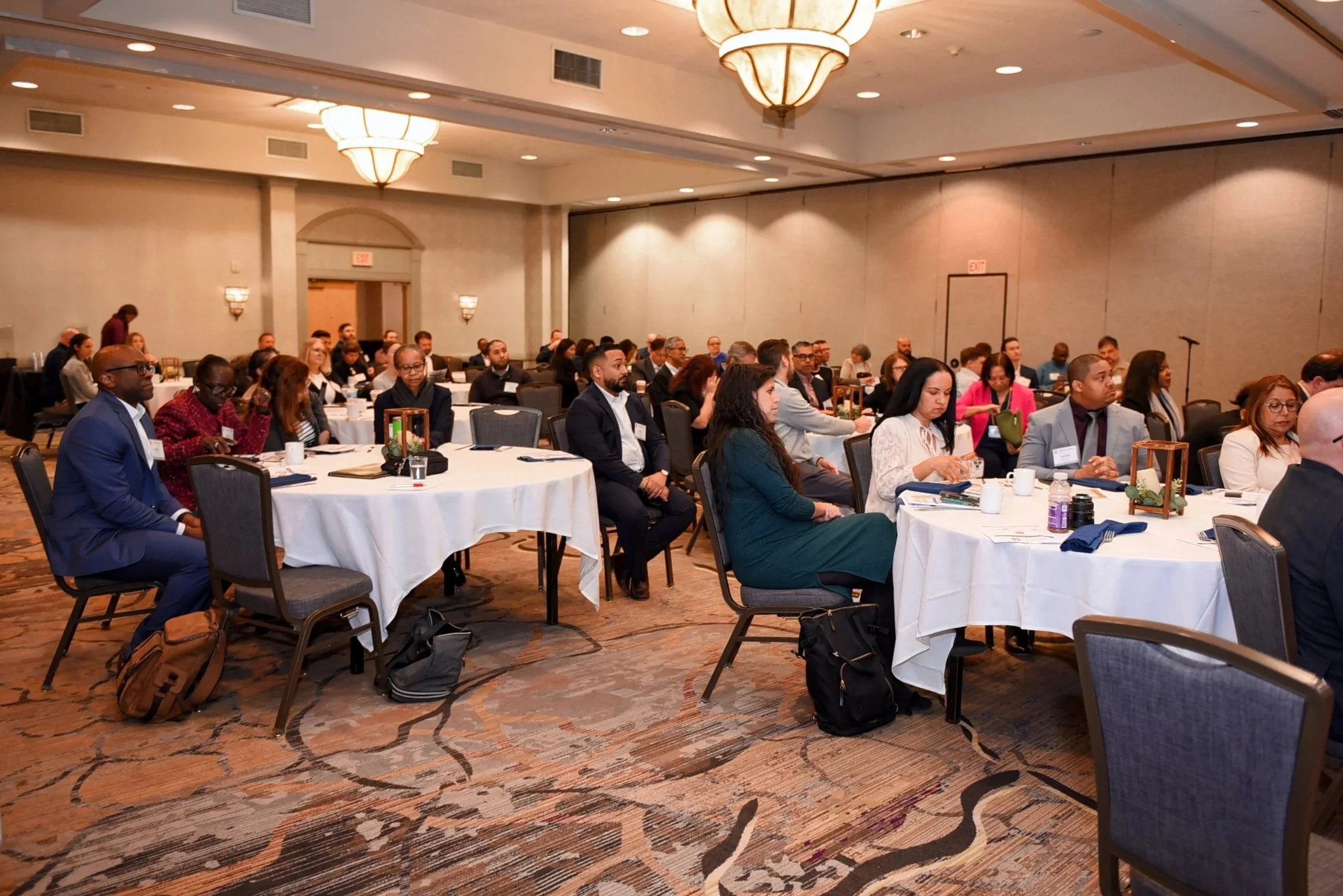
Attendees at the 2026 New York State CDFI Coalition Meeting.
Credit: Joan Heffler Photography
This is a moment to remember, as financial writer James Grant wrote, that lending is a financial transaction with a moral lineage. What he meant is that no one lends money unless they believe in their borrower’s future. The wisdom in the idea that CDFI borrowers are good borrowers is backed up by industry data showing net charge-offs comparable to mainstream lenders.
CDFIs are often the first, if not the only, institutions to believe in the future of their borrowers. By leveraging the scale and scope of the financial system—banks and non-banks—into our communities, we created the possibility that the people and places we serve can, and will, transform that moral lineage into transformative opportunities for tens of millions of people we as CDFIs will never work with directly.
Third, non-financial corporations, starting with Starbucks, with significant, if transient, stops at Google, Netflix, and other companies. The Create Jobs for USA partnership that Opportunity Finance Network built with Starbucks in 2011, extended the capital reach of CDFIs to a part of the economy we did not know we would bring into the CDFI worldview. More than the money we raised with and through Starbucks—about $17 million, as I recall, that resulted in more than $110 million in CDFI financing—Create Jobs boosted CDFI visibility to a level we fantasized about in our most irrational (or inebriated) moments. Howard Schultz, who was nothing if not a marketing genius, directly oversaw the Create Jobs ad we used to launch the campaign during one of the most-watched World Series Game 7s ever. He and I also went on a media tour promoting CDFIs, and we made more than 1 billion social media impressions in just 30 days.
Starbucks led directly to Google’s $180 million commitment to CDFIs in March 2020 as COVID wrecked our economy. The Chief Communications Officer I worked with at Starbucks in 2011 was the Chief Communications Officer at Google in 2020 when its execs gathered to decide what its philanthropic response should be. I heard later that he offered up, ‘Well, there is this group we worked with at Starbucks in 2011.’ Google’s investment, of course, sparked Netflix’s investment in CDFI depositories and minority depositories, and other tech companies joined in.
Fourth, government. The CDFI Fund is unique in the federal government. We take its form for granted now, but in 1993 and 1994, we argued that, first, the federal government should not do anything that harmed CDFIs, and, second, that the best way for the government to help was by making capital investments in CDFIs. Not operating support—the legislative intent was clear that the Fund was not designed to provide operating grants. That was overturned by a Treasury Department lawyer in 1995 or 1996.
Still, we transformed how the government worked. With CDFI Fund certification and capital investments based on business strategies and management strength, the Fund, for its first 15 or 20 years, proved a new, better way to support community development. The framework we asked for and got mapped easily onto state support for CDFIs—here in New York, in California, New Jersey, Pennsylvania, and Michigan, to name a few states— and across the federal government.
The competitive, performance-based application system the Fund used in its early years worked well for CDFIs, which blend public and private goals, resources, and practices. It does not work so well for other would-be applicants. As a result, CDFI-anchored public policy is sticky, resilient, and enduring.
2025 tested that. But the Fund was never in peril in 2025, in my view.
The reason for that, rooted in our unique bipartisan strength, makes me think that there is a higher level yet at which CDFIs can, and should, play a transformative role: as an antibody protecting liberal democracy from the spread of autocracy in the United States, the body politic’s resistance to kleptocracy, oppression, moral and ethical decline, and the despair they fuel.
The Republican-led bipartisan opposition last Fall to the Trump Administration’s efforts to suffocate the CDFI Fund only seemed to come out of nowhere. Like you, I want to think that our advocacy made Congress act. That Members of Congress carry in their hearts and minds the stories we share with them and the data we pile on them.
Yes, and…. I believe something else was at work, as well. Something more powerful, more enduring, more important.
Lost in our relief that the Fund survived is the fact that the Republican-led bipartisan campaign was the first time (in the second Trump Administration) that Republicans in Congress publicly went toe-to-toe with OMB’s Russ Vought and, in his shadow, President Trump.
It was the first real, publicly visible Republican resistance to the Trump Administration. It was the tiny crack in Republican policymaking that has widened gradually in other areas—around ICE, for example, where the people and communities of Minneapolis stood up in organized opposition to corrupt and abusive practices.
It is easy to overlook how important that Republican leadership initiative is. Ten years ago, CDFIs were generally thought to be one or two or three bipartisan ideas in national policy. But now the evidence suggests that CDFIs are not just one of a few bipartisan ideas; that, in fact, CDFIs may be the only remaining bipartisan idea.
CDFIs are not just one of a few bipartisan ideas; in fact, CDFIs may be the only remaining bipartisan idea.
In that way, CDFIs hold a special place in the hopes of policymakers. To give up on CDFIs in the current toxic policy environment is to give up hope.
I heard someone say recently that relationships throw sand in the gears of autocracy.
I think that CDFIs are made up of several deeply rooted values involving relationships that work as sand in the gears of autocracy.
Community.
Trust.
Ethical choices.
Transparency & candor.
Consistency.
Moral standing.
I have long said that CDFIs sound great in practice, but they’ll never work in theory. We defy easy classification and resist politically expedient smears. And we stand for things that Members of Congress value across the political spectrum.
Even the most MAGA elected official understands that CDFIs are capitalists, of a sort. They overlook the fact, however, that we are the visible hand of public good that proves that Adam Smith’s invisible hand is necessary, but not sufficient.
I recently read Anne Applebaum’s important book, Autocracy, Inc.: The Dictators who Want to Run the World.
Liberal societies, she wrote, “can be destroyed from the outside and from the inside, too, by division and demagogues,” she warns. “Or they can be saved. But only if those of us who live in them are willing to make the effort to save them.”
She describes a Syrian Civil Defense team known as the “White Hats”: 3,300 volunteer first responders who documented human rights violations and helped tens of thousands of Syrians recover from bombing campaigns:
Following the Syrian government’s use of sarin gas [against its own people] in 2017, a White Helmet volunteer testified that he’d seen people ‘fainting, completely unconscious … cases of trembling and convulsions, foam coming out of the respiratory tract and mouth.’ People believed him,” Applebaum explains, “because the White Hats were ordinary people who helped other ordinary people, because their work created trust. [Emphasis added]
“The White Helmets created feelings of solidarity, humanity, and hope,” she explained, “To win the war, Russia and Iran needed ordinary Syrians to feel despair and apathy, and the rest of the world to feel hopeless.”
I am suggesting to you today that Republicans in Congress rallied around CDFIs because they understand that ordinary people in their districts and states trust CDFIs and that CDFIs foster solidarity, humanity, and hope in the face of despair.
And I am calling on you and your peer CDFIs to own the responsibility of throwing sand in the gears of autocracy, of doing your work in your communities as a force for solidarity, humanity, and hope.
All it takes to play perhaps your most important transformative role in a transactional business—upholding democracy—is to keep at it, keep doing what you already do, no matter the external circumstances.
To that end, CDFIs need to look to the future, knowing that it will be different in significant ways from the past.
To understand the near future, 2026, and beyond, we need to first look at CDFI behavior in 2025 through clear eyes. To that end, I want to tell you a cautionary story from 1993, when the CDFI Fund was taking shape.
One area of significant disagreement among community development advocates at the time was the question, What defines a “financing entity”? At the CDFI Coalition, we believed that, for the purposes of the CDFI Fund, a financing entity dedicates more than half of its balance sheet or spends more than half of its expenses on financing. We thought that was a minimal standard, not an aspirational one. To be clear, the CDFI Fund has watered that definition down over time.
Opposition to the Coalition’s position came most loudly from advocates for community development corporations (CDCs), some of which did a small amount of lending and a very few of which did a lot.
The too-short history of CDCs is that they started in 1965 with the Bedford Stuyvesant Restoration Corporation and grew at a dizzying pace through the 1960s and 1970s to more than 20,000 as part of The Great Society programs launched by President Lyndon Johnson. They were vitally important in many places and successful at many things that were previously impossible to imagine. It helped, and later hurt, that they relied primarily on government funding for their operating costs.
In 1993, some of us at the Coalition thought that CDC over-reliance on government funding for operations made them dependent on and therefore overly deferential and compliant to federal policy makers over community interests.
Near the top of our list of concerns in shaping the CDFI Fund was that CDFIs could get addicted to CDFI Fund money for operations that would eventually undermine their independence and erode their focus on their communities.
As CDFIs overtook CDCs at the center of federal community development policy, we managed an uneasy equilibrium in use of funds across the CDFI industry … until 2025. I want to make it clear that I think that few CDFIs actually are overly dependent on CDFI Fund awards for operations, though I’m surprised how many think that they are.
The consequence I saw of that CDFI behavior in 2025 is that CDFI allies who do not understand how CDFIs or the CDFI Fund actually work pulled back sharply because of CDFIs’ behavior. I’m talking about foundations and philanthropists, Mayors and county executives, and most bankers, save for the small number of large banks that know CDFIs well.
I wince to remember how many times I heard them tell me over the past 15 months that they were waiting out the CDFI Fund fight because they were hearing from the CDFIs that the industry would go belly up if the Fund did not survive.
I don’t think CDFIs were saying that, but that is the message they heard in the anxious reactions CDFIs had to the Trump Administration’s bluster about the CDFI Fund. As an old cartoon I used to quote said, “We have met the enemy, and they are us.”
Some CDFI staff members, Board members, borrowers, and others also believed what they were hearing and seeing. Perhaps some Members of Congress did, too, and there is an argument to be made that they helped to catalyze the resistance last year.
I don’t buy that, and I can’t prove it wrong.
What is undeniable, though, is that the CDFI industry fell into a vulnerable, defensive crouch—understandable but unacceptable with the brazen, unfounded attacks on not only the Fund but the EPA’s Greenhouse Gas Reduction Fund. My message today is that the CDFI industry needs to stand up out of its crouch.
Martin Paul Trimble, Cliff’s co-conspirator 35 years ago and my predecessor at OFN, reminds us that CDFIs need to embrace their “institutional ego,” to expect others to believe CDFIs are as important as we believe they are.
We are in a unique, extraordinarily potent position in 2026 and looking ahead because of what happened in 2025.
Your work as a Coalition in New York state is one step forward.
The growth in the number of state CDFI coalitions is another, as I hope is the effort to create a coalition of state CDFI coalitions; I worry about layers of complexity.
Making New Markets Tax Credits and Low Income Housing Tax Credits permanent, as Congress did last year, is net positive, though not without complications for CDFIs.
The effort in Congress to pass the AFFORD Act is important.
The letter last week demanding that the Trump Administration release more than $1 billion for CDFIs and others in support of affordable housing is necessary and good. Still, it is a rearguard action, consuming political capital to recover something that is already ours.
Even Opportunity Zones—which I believe make up the worst public policy ever created related to community or economic development—might have an “up” side, if CDFIs focus on making them work.
Many of the banks that backed away from diversity, equity, and inclusion in general and CDFIs in particular are inching their way back to CDFIs again. The unwillingness of the Trump Administration to support or enforce the Community Reinvestment Act (CRA) took some pressure off of the banks, but soon enough, many banks realized that whatever they do in 2026 under CRA will be evaluated after 2028, presumably when there is a new Administration in office.
Do not assume that the responses you got from bank partners in 2025 will be the same in 2026 and 2027.
But the future of CDFIs demands of us all more than business as usual.
When I look into the future of CDFIs, I am not concerned about the Fund’s survival, or even its ability to deliver programmatic funding in 2026 and beyond. I expect we will see the Trump Administration backing off its opposition to the Fund this year despite its ongoing threats.
You will know they are giving up when they declare victory.
The first round of CDFI Fund awards in 1996 was $36 million for an industry that I’ll guesstimate generously was $3 billion. A comparable appropriation now relative to industry asset size would be on the order of $5.4 billion. We’re not greedy, but how about demanding $2 billion for the Fund?
In this environment, it won’t happen, but what would it mean to ask for it? And what does it mean that we don’t?
At the same time, under-leveraged CDFIs need to make more efficient use of their balance sheets with innovative approaches and locate additional sources of capital and funding.
CDFI industry consolidation—mergers and collaboration—is going to increase. What would support that in a way that centers community impact?
The legal fight goes on to salvage the Greenhouse Gas Reduction Fund—another rearguard action. But who is planning for GGRF v2.0 in a new administration in 2028? Or even 2032? It involves a lot of money, but that does not mean CDFIs should accept the program design as it was. How can Congress improve it?
In 2012, OFN published a comprehensive set of policy recommendations for the second Obama administration called Opportunity Next. It was the CDFI industry’s attempt to use our “visible hand” to do what The Heritage Foundation did for the second Trump Administration with Project 2025.
It seems to me that CDFIs should be working now on CDFI NEXT 2029.
We need to account for material changes in the composition of the CDFI industry generally and the certified CDFI sub-sector in particular. In 2023, the most recent year we have data for, community development credit unions did more than two-thirds of all CDFI lending recorded by the Fund. While loan funds continue to make up the greatest number of CDFIs, the volume and reach of CDFI financing for the foreseeable future will grow primarily through credit unions.
That has big implications for CDFI Fund policies.
Artificial intelligence is starting to reshape and possibly redefine our industry as we meet. Will it reduce CDFI operational inefficiencies? Change how we think about underwriting? Affect our ethical practices? Reduce CDFI employment? Plug us into a new set of lending partners? Or possibly make us better at what we do in ways we can hardly imagine today?
Private credit funds in the mainstream markets had a “moment” as they grew over the past year and now are having another “moment” as they fracture and, likely, fail. Will their performance cast a shadow on ours? Or is this another area where CDFIs can transform the marketplace by example—we don’t want to become them, we simply have to show how revolving credit funds are run sustainably and responsibly.
In 1992, CDFIs recognized the need to become advocates for CRA. We have succeeded together since then, but CRA advocacy has changed, and CDFIs are largely absent.
No CRA means fewer and smaller CDFIs. Where is the CDFI industry-wide support for CRA?
By now, you are—at least you should be—tired of my judgments and opinions. My point is this:
The future of CDFIs will be bright and enduring … if we as a sector are prepared to see the facts before us with brutal honesty and never stop believing that we will prevail.
That’s a worldview know as the Stockdale Paradox. It is named for Admiral James Stockdale, the senior ranking officer among American prisoners of war in the Hanoi Hilton, as it was called, in North Vietnam. Stockdale concluded that the POWs who viewed their conditions with brutal honesty but never stopped believing that they would go home made up the group who survived and, in fact, went home.
“Oh, you mean the optimists,” someone asked him.
“No,” he explained, “the optimists all died of broken hearts. They kept telling themselves they would be free by Easter or Passover, and then by the 4th of July, by Thanksgiving…”
The pessimists, he added, never gave themselves a chance.
I shared that story at least 100 times in 2003, 2004, and 2005, to explain how OFN had arrived at the conclusion that the CDFI industry needed to grow, change, or die. It chose to grow, and it changed. It is changing still.
But it may not be changing fast enough to outrun events that are evolving at the speed of an AI search response. When I say “The Future of CDFIs is a Narrow Bridge” I mean today that our options are different and narrower than they were 23 years ago. Today, our options are to change or die. Growth is fine, if it comes, too, and it will. But our primary focus must be on industry and individual CDFI change in pursuit of the transformation of our communities, our policy and politics, our national culture, and our democracy.
It is not my job to advise CDFIs or the CDFI sector to change. But here are a few seismic shifts that seem inevitable and essential:
No one called for “Scale” more than me. Done.
Now I am calling for “Scope.” Or CDFI coverage: How do CDFIs become truly national by bringing their lending to all the places that need them?
There are 1,272 places—about one-third of all places in the U.S.—where at least half the census tracts are Qualified Investment Areas (IAs)—meaning they are economically distressed—that have seen low levels of CDFI financing on a per capita basis since 2005. CDFI Friendly America defines these places as “CDFI Opportunity Markets.” I estimate it is at least a $60 billion market just to bring these opportunity markets up to the national average.
Houston, TX, for example, is the nation’s largest CDFI Opportunity Market. CDFIs have loaned $280 per person there, 34% of the national per capita average for CDFI financing, while 65% of its census tracts are economically distressed.
Storrs, CT, on the other hand, is the nation’s only place where 100% of the census tracts are IAs, and there is $0 in CDFI financing.
I created CDFI Friendly America in 2019 with the late Adina Abramowitz to develop a model for fixing this problem. Our model is working in places as different as Tulsa, OK, and Bloomington, IN. It may not be the best model for creating efficient distribution of CDFI lending across geographies to achieve CDFI coverage, but so far, it’s the only one.
By the way, the data I’m citing are available for free in our CDFI Market Map.
The key to national coverage, it seems to me, is to stop shining the spotlight on CDFI asset size and total CDFI industry asset size and to focus instead on CDFI financing activity.
How much? Where? Who? In other words, center the CDFI narrative around what we are achieving in our communities and not on what our potential is.
Soon—I would have said “in 2026” but who actually knows?—The CDFI Fund is going to expand its transaction-level reporting requirements from CDFIs with active Fund contracts to all certified CDFIs. The data will transform what we know about the CDFI industry and what it is doing. We should be out ahead of that data expansion.
These data make a powerful advocacy weapon, as well. We poured our data into a second map, the CDFI Advocacy Map, that displays CDFI lending by state, congressional district, and state legislative districts. It can help you in New York. In fact, Colleen, we would be glad to provide a short Zoom demo of how the NY State CDFI Coalition and its members can use the Advocacy Map in support of funding.
Conclusion
“It’s deyn America,” my Yiddishkeit Grandfather used to say. “It’s your America.”
I came here today to tell you, “It’s deyn CDFI future.”
The question is not whether we can survive and, very likely, thrive. The question is what you are going to do differently—as individual CDFIs, as a statewide Coalition, as a sector, and as an industry—to maximize our leverage to transform our communities and our nation. And to throw sand into the gears of American autocracy.